



When the tip is used with a pipette, it is mainly used in various pipetting scenarios. Because the pipetting of liquids is the basic operation of all experiments in the laboratory, the pipette and its associated tips are the most commonly used consumables in the laboratory. In order to meet a variety of different pipetting needs, its types are also rich and diverse. Below are some of the common types of tips on the market.
1. Pipette tips
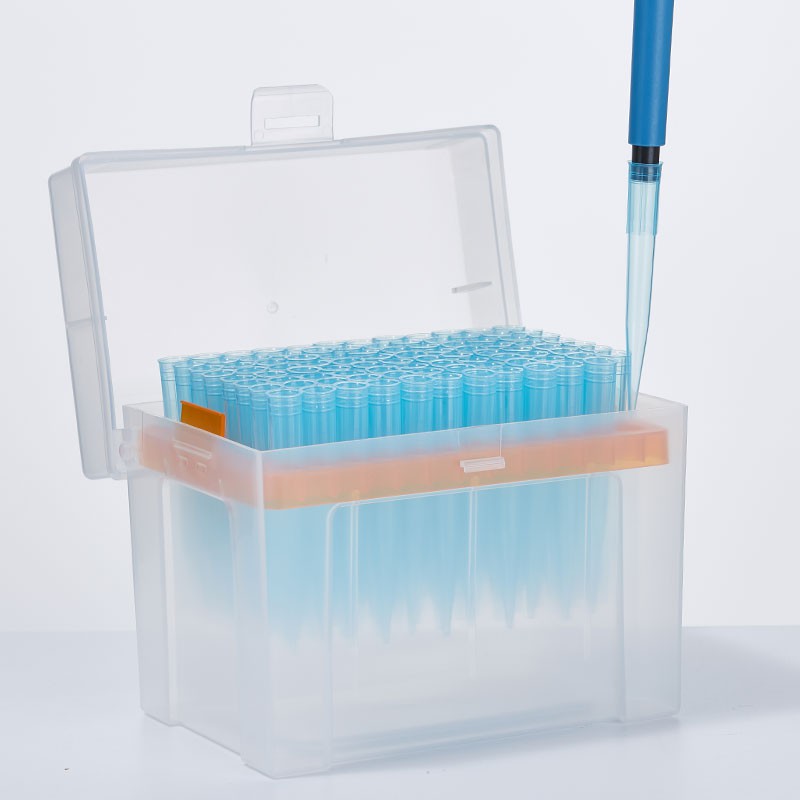
The most common type of tip is also the most widely used tip. It can be used in almost all pipetting operations. This is the most economical type of tip. If there are no special requirements, universal tips can be used and can meet most pipetting needs.
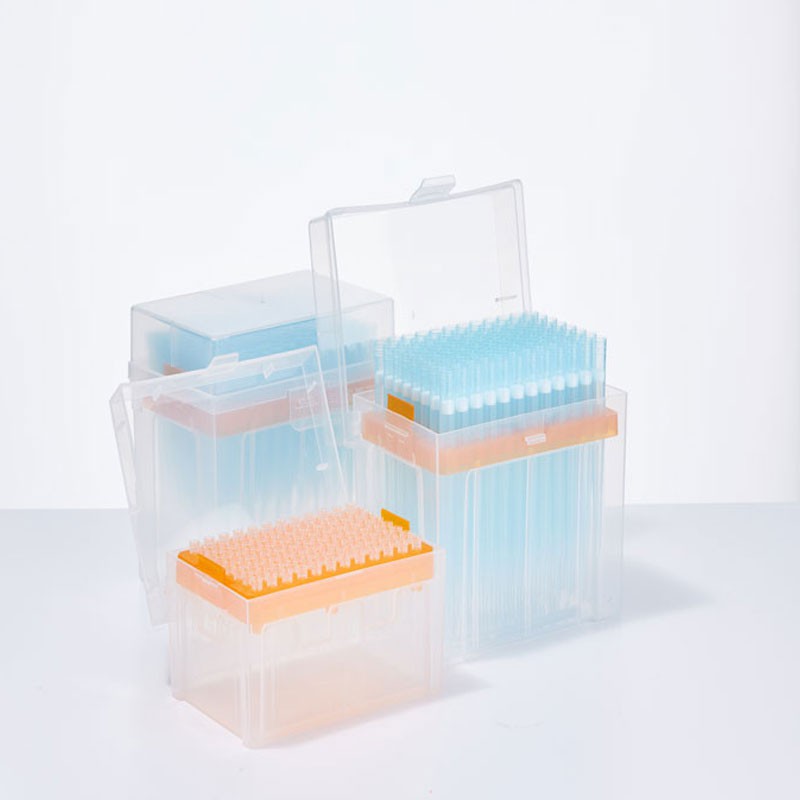
Other types of tips are also evolved from standard ordinary tips. Standard tips are generally packaged in many ways. There are three common types on the market: bagged, boxed, and pre-packed (stacked). Generally speaking, boxed products will provide sterilized products, while bags and pre-packed plates less provide sterilized.If users have special requirements for sterilization, they can directly purchase boxex package which already sterilized,or put unsterilized bagged tips into an empty tip box and sterilize them before use.
Most of the tips and tip boxes on the market are made of PP polypropylene, so they can be processed at high temperature and high pressure in a sterilizer. Among them, the common packaging is boxed with 96 pieces/box, and the spec. is 12×8, so that it can be used with multi-channel pipettes and 96-well plates.
2. Low Retention Pipette Tips
No matter what type of tip is selected, a low residual rate is a key point. If we carefully observe the use of the tip, we will find that when discharging liquid, there is always a part of liquid cannot be discharged and remains inside the tip. No matter what the experiment is, this will cause some error in the results. If this error is within an acceptable range, you can still choose ordinary tips for use.
For experiments that require high sensitivity, or precious samples or reagents that are prone to residues, low adsorption tips can be selected to improve the recovery rate, in order to obtain more accurate experimental results and higher recovery rates for precious samples. The surface of the low adsorption tip has been hydrophobic treatment, which can reduce the surface tension of the liquid leaving more residues in the tip.
Although that sounds great, in practice these tips are rarely used. Because as a type of product that is used in a large amount in the laboratory, the cost of the tip is also a factor that users will consider. The price of this kind of specially treated tip is indeed more expensive than the standard tip. Of course, in terms of appearance, there is no difference between the low adsorption tip and the ordinary tip.
3. Pipette With Filter Tips
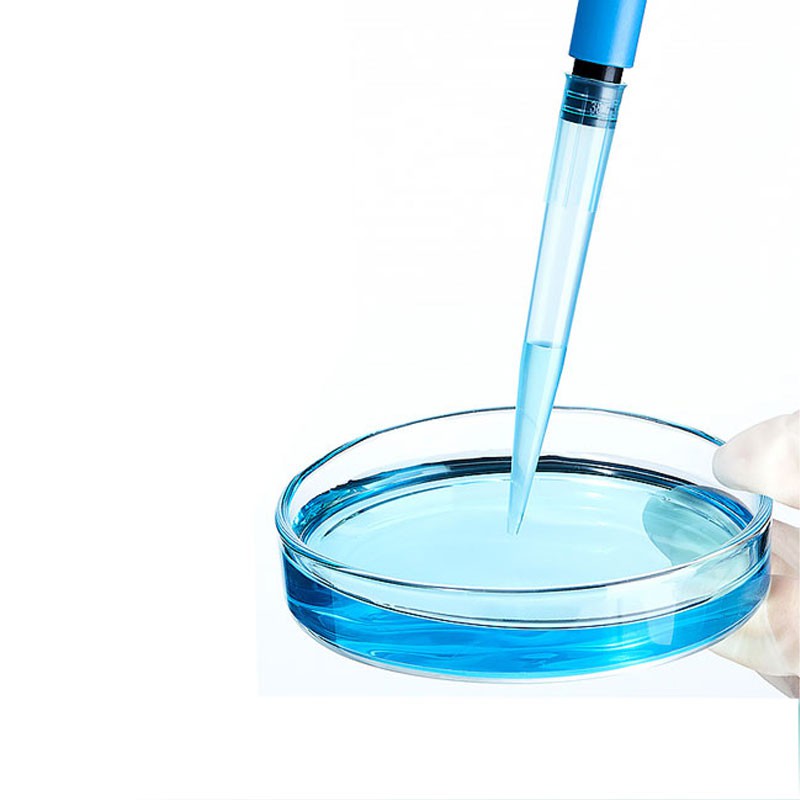
The filter tip is a consumable designed to avoid cross-contamination, with a filter at the top of the tip. Use the filter tip to remove the sample, so that the sample cannot enter the inside of the pipette, so as to protect the parts of the pipette from contamination and corrosion, and more importantly, it can also ensure that there will be no cross-contamination between samples.
For example, it can effectively prevent the contamination of the pipette in scenarios such as molecular biology experiments that cause the liquid to return to the inside of the pipette due to the misoperation of the experimenter, or in the case of molecular biology experiments, etc. In related experiments, filter tips can better protect the safety of the experimenter.
Of course, in fact, for filter tips, most of the ordinary filter cannot provide a real barrier function, and can only relatively slow down the process of liquid entering the pipette. Only some high-end tips can provide a real barrier. function, to achieve complete isolation. Filter tips are usually pre-sterilized and free of DNase/RNase, and are often used in experiments such as molecular biology, cytology, and virology.
4. Wide Mouth Pipette Tips
The difference between these tips and ordinary tips is that they have a larger opening at the lower end, which makes it easier to remove liquid, and provides less mechanical shearing. When handling viscous substances, ordinary tips should have a small opening at the lower end, which is not easy to aspirate and drain the liquid, and will also cause higher residues. The design of wide mouth is more convenient for handling such samples.
When faced with samples of genomic DNA and fragile cells, too small opening mouth is easily cause damage to the sample during operation, cell rupture, etc. The wide mouth tip is about 70% larger than that of the ordinary tip, which is the best way used to remove fragile samples.

5. Gel Loading Pipette Tips
The difference from ordinary tips is that the bottom end provides a very slender extension. When used for gel loading operations such as electrophoresis, this tip can penetrate deep into the sample wells of the gel, because the volume of such wells is very small, and ordinary tips are difficult to perform sample loading operations, or it is easy to spill out, gel loading pipette tips are suitable for use in such small-volume containers.

6. Extended Pipette Tips
Compared with ordinary standard tips, the length is simply extended. Although different brands of tips on the market may have different sizes including length, the extended tips are still much longer than regular tips.
If the container is very deep, such as the common 15ml centrifuge tube on the market, at this time, the ordinary tip cannot absorb the liquid, and this operation can be done by extended tips.

7. Automated Pipette Tips
Unlike the above-mentioned tips, automated tips are mainly used with a workstation. The workstations in the Chinese market are almost monopolized by imported brands. The workstations of these five brands, Tecan, Hamilton, PerkinElmer (PE), Beckman, and Agilent, almost monopolize the entire industry.
Compared with traditional manual pipettes, automated workstations are actually a high-throughput option. Work with other types of automated equipment, such as automated cryopreservation systems, nucleic acid extractors, etc., high-throughput experiments can be realized. automation, improving efficiency and freeing up manpower.
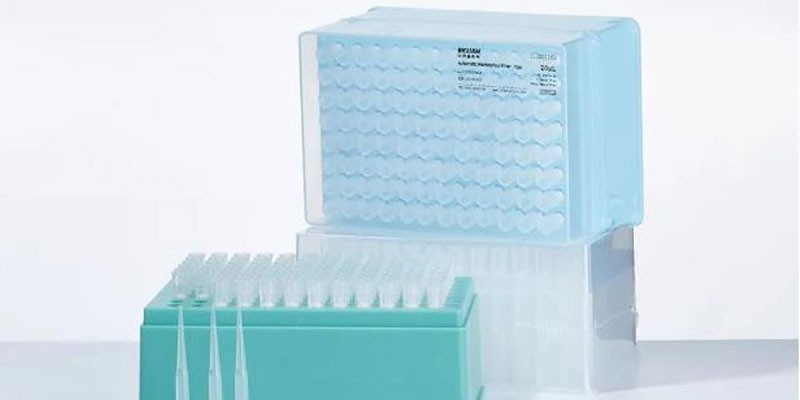
BKMAM offer universal pipette tips,filter pipette tips,low retention pipette tips,extended pipette tips,automated pipette tips,good quality with factory price.Different volume 10uL,100uL,200uL,300uL,500uL,1000uL 1250mL,10mL,5mL pipette tips welcome to choose as your need.