

Spectrophotometers cuvettes are often used for quantitative and qualitative analysis in spectral analysis. We all know that unclean cuvettes will lead to errors in the results, but many people do not know how to choose the cuvettes properly, it will also affect the experiment.
Therefore, when use a cuvette, there are certain aspects enfluence.
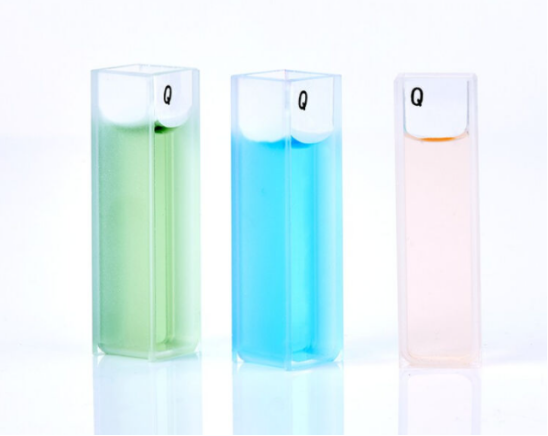
Classification of cuvettes:
According to the wavelength range used, it can be roughly divided into glass cuvettes (visible light) and quartz cuvettes (ultraviolet light). The glass cuvettes absorb almost all ultraviolet rays, and the absorbance is very large. The absorbance of quartz cuvettes is much smaller. Therefore, quartz cuvettes are used in the ultraviolet region, but in the visible light region, both quartz cuvettes and glass cuvettes can be used, and glass cuvettes are generally used.
Optical path selection of cuvettes:
The optical path of the cuvette refers to the distance between the inner walls of the cuvette. Generally, 0.5, 1, 2, 3, and 5 cm are commonly used. The optical path will affect the light absorption value of the sample, so which optical path ratio should be selected? The color dish needs to be determined according to the absorbance of the sample. When the color of the colorimetric solution is light, choose a cuvette with a larger optical path length, such as: 2cm, 3cm; when the color of the colorimetric solution is darker, you should choose a small optical path length, such as 0.5cm, 1cm Cuvette.

How to tell the difference between glass and quartz cuvettes:
The definition of ultraviolet region is 190-400nm, quartz cuvette can be used for 190-900nm, glass cuvette can be used for 360-900nm, the ultraviolet region must use quartz cuvette, and use UV/Vis spectrophotometer, otherwise The low wavelength band cannot be analyzed. Under normal circumstances, it is impossible to distinguish quartz cuvettes and glass cuvettes with eyes, but in terms of physical properties, the hardness of the two is very different, and the hardness of quartz cuvettes is dozens of times greater than that of glass cuvettes. In addition, there is a Q on the quartz cuvette (quartz quartz), and there is a G on the glass (glass glass), and the two cuvettes can be directly distinguished by the word mark. However, not all cuvettes sold on the market are marked. In this case, the absorbance of an empty cuvette can be detected at ultraviolet wavelengths, and the absorbance of glass is greater than that of quartz.

How to wash the cuvettes:
The principle of choosing the cuvette washing solution is that the decontamination effect is good, the cuvette will not be damaged, and the measurement will not be affected at the same time. Usually, it can be washed with water. If it cannot be washed with water, for example, if the test solution is an acid, use a weak base solution; if the test solution is an alkali, use a weak acid solution; if the test solution is an organic substance, use an organic solvent, such as alcohol and other solutions.
So now you know how to choose and use the cuvette.
BKMAM provide all full range quartz cuvette and glass cuvette. Any further information needed on the spectrophotometers cuvette, welcome to contact BKMAM team:
Email: tina@bkmbio.com
Tel/ whatsapp: +8618102756038/ +8619936789959


